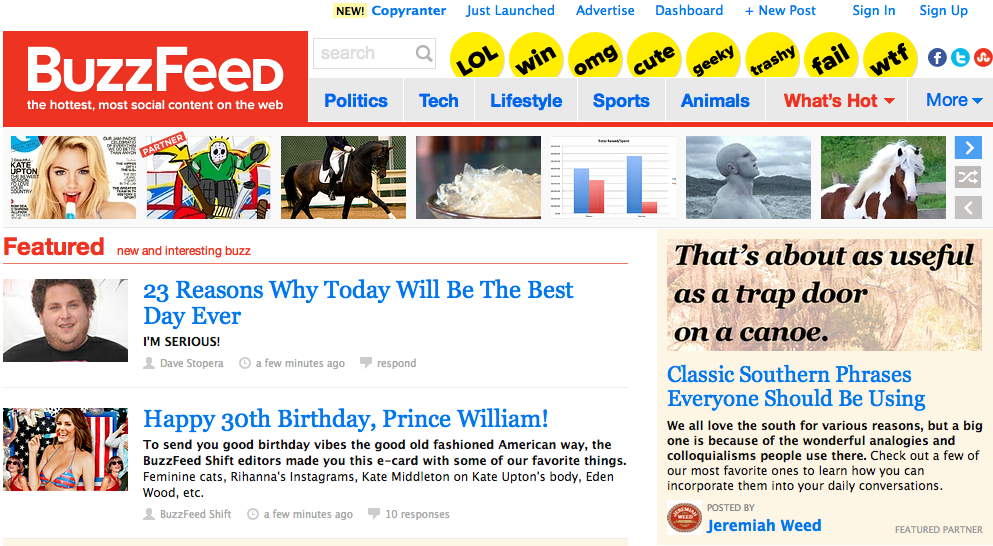
In a media world gone social, it’s no surprise that a publication with such a venerable history as The New York Times would partner up with a new-style publisher like BuzzFeed. The two publications said earlier this week that they’ll collaborate on their coverage of the Democratic and Republican national conventions later this summer, including sharing video feeds.
The deal is a big validation for BuzzFeed, which until recently was mostly known for its must-share listicles on topics like “The 21 Absolute Worst Things in the World,” “The Only 20 Books You’ll Ever Need to Read in Real Life” and “The 12 Cats of the Zodiac.” The company has made a dramatic shift to producing original content, bringing on former Politico reporter Ben Smith to helm a growing news operation that is trying to marry BuzzFeed’s social expertise with serious, original reporting.
“We are getting better at paying attention to how social media drives the story,” explained Jim Roberts, assistant managing editor for The New York Times. “Ben and his crew are excellent at doing that, and we’ll be relying on their ears and taking advantage of that, but it’s not just social media. They can really help create interesting programming.”
Roberts believes social media provides the perfect opportunity to reach a broader audience. But he understands the risks that many in the legacy world fear. For example, he acknowledges a legitimate concern that social media could create a disincentive for users to visit a particular news site, but, he added, “you have to be very cognizant of how your audience consumes news and information — and how they want to receive it. It’s our obligation to make sure we service as many avenues as possible.”
With this in mind, Roberts advises other legacy publications to embrace social media. Use it to listen to the conversation and discover how articles and videos are shared, the means by which people are sharing and what they’re saying about the content.
“In politics, social is where everyone is. No one who matters isn’t there,” said Ben Smith, editor-in-chief of BuzzFeed.
Smith sees this as an opportunity to intertwine social, live stream and smart reporting, believing that the social conversation around politics is “massive.” And, he added, while the conventions have in the past been viewed with the same excitement as three-day-long infomercials, people will be joining the conversation through Twitter.
“Having them so deeply enmeshed in the social conversation about politics will rub off on us in a good way,” said Roberts. “Seeing the campaign through their eyes is going to be different than through the eyes of a more traditional news media. I think we’ll benefit our audience by giving them a different angle on the story.”
Despite this benefit, though, both Roberts and Smith acknowledge that their respective publications could be seen as competitors. “We have to be very aware of that potential. If people can fulfill their needs for news information and entertainment in one space, that is a reason to be concerned,” noted Roberts.


More in Media

‘A Super Bowl every two days’: Inside Unilever’s 50,000-creator World Cup play
50,000 creators activated globally, massive in-person pop-ups in host cities, and more are all part of Unilever’s World Cup creator push.

Amazon expands media footprint with iHeart sales deal and new TV outcome tool
Amazon is deepening its role in streaming advertising with an expanded iHeartMedia sales deal and outcome-based TV buying technology.
Media Briefing: Inside publishers’ real Cannes agenda – AI money vs agentic hype
For publishers, Cannes this year isn’t just about showing up for clients and sponsors. It’s a mid‑year checkpoint on two hard questions: who is going to pay for the open web in an AI world, and whether agentic media buying is a real fix or just a freshly branded ad‑tech tax.