Join us Dec. 1-3 in Nashville for the Digiday Programmatic Marketing Summit
By the numbers: Ad tech’s widening divide, as AppLovin surges and rivals struggle in Q3

The latest quarterly earnings from six of the publicly traded ad tech companies reveal a tale of two cohorts, with AppLovin and Unity’s substantial growth contrasting with declining revenues at Criteo, Taboola, and Teads.
The companies, which reported their third-quarter results this week, generated markedly different outcomes during the reported period. AppLovin’s revenue increased 55% to $2.19 billion, while Unity posted 32% growth and Magnite reported a double-digit increase. Meanwhile, three of the six experienced annual revenue declines, with Teads suffering the steepest contraction at 26%.
The results also show differences in profitability, with some companies increasing earnings despite lower revenue. Meanwhile, connected TV remained a source of growth for Magnite and Teads, although it was insufficient to offset the latter’s broader decline.
Overall, the numbers illustrate how unevenly the industry’s growth opportunities are being distributed.
The haves and have-nots (well, less)
A top-line observation is that the two strongest performers are mobile advertising rivals AppLovin and Unity, for some, a trend that underlines the decline of the open web and the resilience of app-based media — both mobile and CTV — companies.
AppLovin reported $2.19 billion in third-quarter revenue, up 55% year over year, alongside net income of $1.44 billion, an increase of 72%.
The company also forecast Q4 revenue of between $2.365 billion and $2.395 billion, and told analysts that its Q3 revenue exceeded the combined revenue of the other five companies, which totaled about $1.94 billion.
Unity, a mobile advertising rival of AppLovin — the two are involved in a recently filed, ongoing legal dispute — reported revenue of $622 million, up 32%, with the Grow Solutions division, i.e., the division that hosts its media offering, generating $457 million, an increase of 44%. The company also reported that its Vector ad platform grew 126% year over year and 40% sequentially during the reporting period.
Elsewhere, in the cohort, growth was more modest, if not outright in marked decline (see chart below).
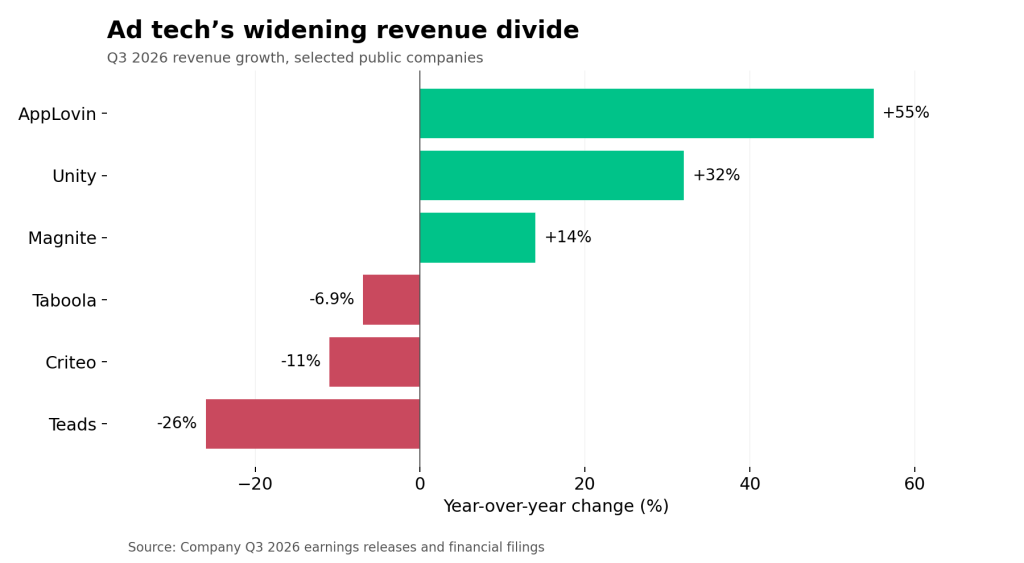
Magnite reported revenue of $204.2 million, up 14%, with growth primarily driven by its connected TV business. Meanwhile, Criteo reported Q3 revenue of $416 million, down 11%, while contribution ex-TAC, i.e., after “traffic acquisition costs”, declined 17% to $240 million.
Criteo’s retail media revenue fell 23%, partly reflecting changes involving two (unnamed) clients that reduced business by $20 million, according to executives there.
Meanwhile, Taboola reported revenue of $462.3 million, down 6.9%, amid declining advertising impression volumes. However, the company’s gross profit rose 9.6% to $152.3 million despite the 6.9% revenue decline.
By contrast, Teads (Taboola’s historic rival and one-time prospective merger partner) recorded the largest decline, with revenue falling 26% to $235.1 million. After TAC, its gross profit declined 28% to $93.5 million, according to the filing, with execs there citing continued weakness in open-internet advertising and not reinstating its financial guidance. In total, this equated to a net loss of $325.5 million, compared with a $19.7 million loss a year earlier.
Profitability varies despite revenue trends
Revenue growth did not consistently align with profitability changes across the six companies in this cohort, with Unity reporting its first profitable quarter since its IPO (see chart below).
By contrast, Teads (Taboola’s historic rival, and one-time prospective merger partner) recorded the largest decline, with revenue falling 26% to $235.1 million. After TAC, its gross profit declined 28% to $93.5 million, according to the filing, with execs there citing continued weakness in open-internet advertising and not reinstating its financial guidance. In total, this equated to a net loss of $325.5 million, compared with a $19.7 million loss a year earlier.
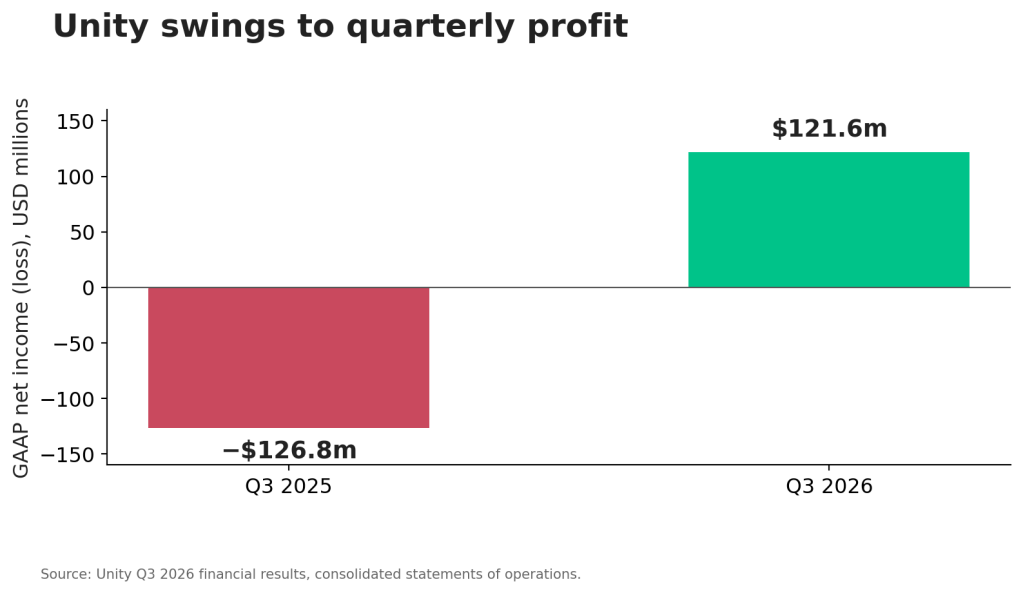
Revenue growth did not consistently correspond with changes in profitability across the six companies in this cohort, with Unity’s fortunes contrasting to Criteo – the company that was initially renowned as an ad-retargeting company, but now preferring to underline its retail media wares – reporting a deterioration in both revenue and profitability. Criteo’s gross margin declined from 55% to 50%, while net income fell 85% to $6 million. The figures show that companies reporting similar revenue trends are experiencing different outcomes in terms of gross profit, net income and cash generation.
CTV continues to outperform other formats
For all the (inevitable) talk of AI, CTV remained a significant source of growth for Magnite and Teads during the quarter.
Magnite reported a 39% increase in CTV contribution, ex-TAC, to $105.4 million, compared with 5% growth in its DV+ business, which includes display and other digital video advertising.

CTV accounted for approximately 53% of Magnite’s total contribution, ex-TAC, of $200.6 million, compared with 45% a year earlier. Overall revenue increased 14% to $204.2 million, while total contribution ex-TAC grew 20%.
CTV growth also proved an oasis for Outbrain’s executive team, with revenue from the channel increasing 37% year over year. However, this was offset by the fact that CTV represented just 12% of the company’s quarterly revenue, compared with its overall revenue decline of 26%. Teads reported nearly $100 million in year-to-date CTV revenue.
Taken in tandem, these results show that CTV continues to grow despite weaker performance in other areas of digital advertising. However, the contribution of that growth to overall company performance depends on the CTV business’s size relative to other revenue streams.
The filings mark the midway point in this quarter’s earnings season, with Zeta Global, The Trade Desk, PubMatic and Lifoff Mobile all due to make their equivalent filings next week.


More in Media

Creators see promise in Instagram’s long-form push, but question whether exposure is enough
Instagram wants to pull long-form creators away from YouTube, but is it offering enough? Experts weigh in on the platform’s pivot.

Media Briefing: Publishers’ revenue growth defies traffic declines, but tougher comparisons loom
The New York Times, People Inc., News Corp and Reuters report revenue growth despite AI disruption, but face tougher comparisons ahead.

What DoorDash’s Instacart acquisition says about the modern delivery platform pitch
DoorDash’s announced plans to acquire Instacart for $17 billion point to the constant need to gain market share by diversifying services and offerings.